
In this article
- Why the paper suggestion box stops working
- What a complaints and suggestions system actually does
- What the rules in Saudi Arabia expect you to publish
- Complaints and suggestions belong in two queues
- The intake form: eight fields that save a phone call
- Routing, owners and status
- A 30 day plan to replace the box
- What to measure in the first quarter
- Where Daftarix fits
- Frequently asked questions
A complaints and suggestions system is the single place where every complaint, request and idea from a customer is recorded, given an owner and answered. In most small companies in Saudi Arabia that place is still a plastic box on a wall, a shared mailbox, or one employee's phone. The box collects paper, the mailbox collects noise, and neither can tell you how many complaints arrived last month, which branch caused them, or how long customers waited for a reply.
This guide walks through the move from the paper box to a tracked digital workflow: what you are expected to publish for customers, how to design the intake form, how to route a complaint to a named owner, what to measure, and how to stop suggestions from being thrown out with the paper.
Why the paper suggestion box stops working
A box works only while volume is low and the owner reads it personally. Past that point it fails quietly, because nothing in it is counted. A business can receive the same complaint about delivery times for six months and find out only when a customer escalates.
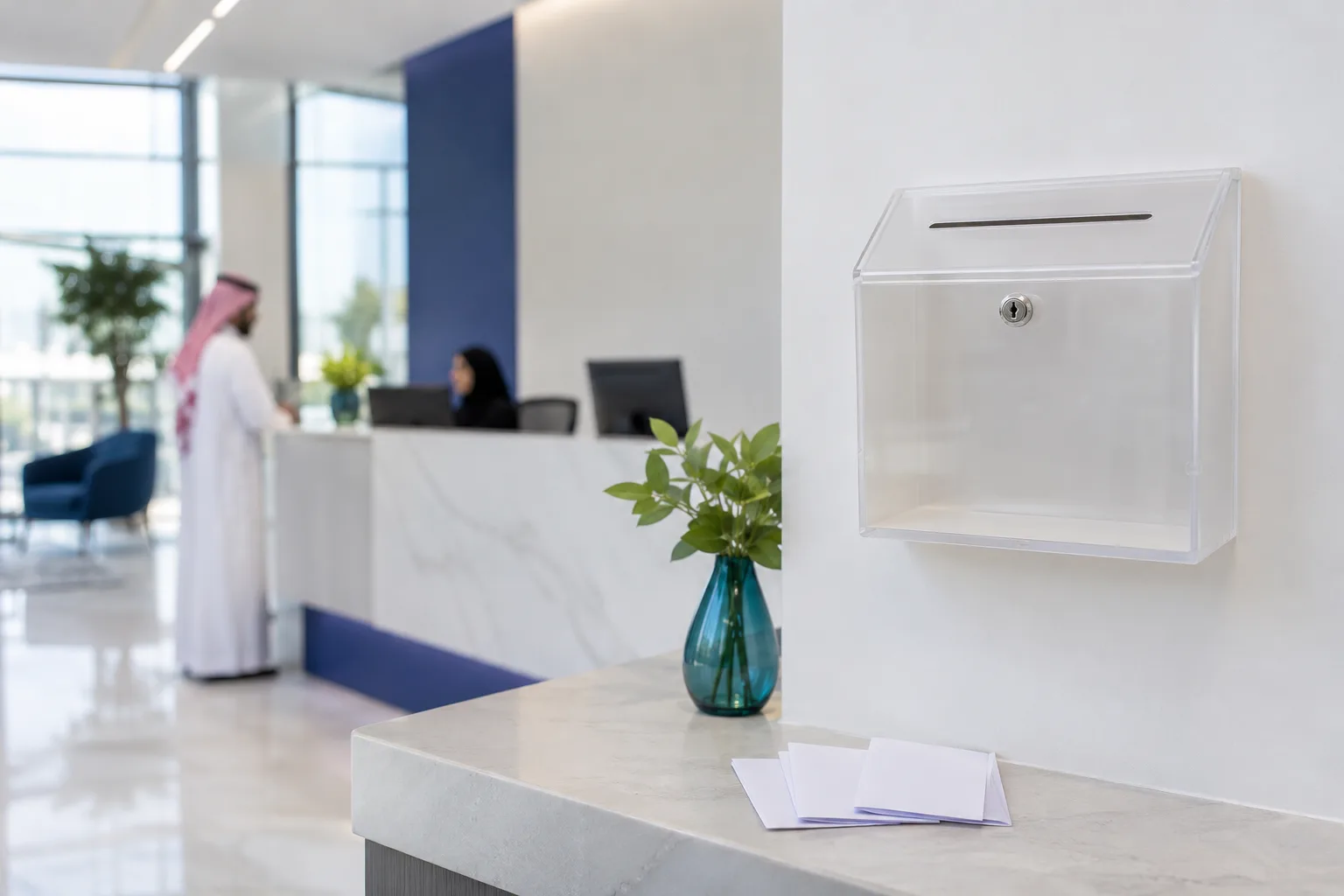
Three failures repeat in almost every company that still relies on paper or a shared inbox:
- No owner. A note that belongs to everyone belongs to nobody, so it waits for whoever next opens the box.
- No clock. Nobody knows whether an item is two hours or two weeks old, so urgency is decided by who shouts loudest.
- No memory. Last quarter's complaints sit in a drawer, so the same root cause is patched again and again instead of removed once.
Suggestions suffer the most. A complaint eventually reaches a manager because the customer follows up. A suggestion is offered once and never repeated, so if it is not logged on the day it arrives, it is gone.
What a complaints and suggestions system actually does
A digital system is not just an online version of the box. It changes four things: intake, ownership, status and reporting. Every item becomes a record with a number, a category, a priority and a named owner, and every reply is stored on that same record.
In practice the team gets:
- one queue for complaints and one for suggestions, both visible to everyone who needs them;
- a category on every item, so patterns such as billing, delivery or service quality become visible;
- a priority, so a stopped service is handled before a cosmetic request;
- the customer's history on screen while the reply is being written;
- counts and resolution times you can take into a monthly meeting;
- a closing step that asks what should change so the complaint does not return.
What the rules in Saudi Arabia expect you to publish
If you sell online, the complaint channel is not decoration. The implementing regulation of the Saudi E-Commerce Law requires, in Article Six, that a service provider disclose in its electronic shop the privacy policy, the tax number where one exists, and the "procedures and methods used to receive and resolve Consumer complaints", with a link to that information in the store itself. See the law and its regulation on the Ministry of Commerce regulations page.
In plain terms, a customer should be able to find out how to complain, and what happens next, before buying. A box inside a branch does nothing for a shopper on a phone at midnight.
There is also an outside route that runs in parallel with yours. A consumer who is not satisfied can file a commercial report with the Ministry of Commerce through the Balagh service, available on the ministry's apps and website and through the unified number 1900, which the ministry states operates from 8:00 AM to 12:00 midnight, 7 days a week. The ministry lists 7 working days as the duration of that service. Your own queue should be faster, because a complaint answered in a day rarely turns into a report at all.
Complaints and suggestions belong in two queues
Mixing them is the most common design mistake. A complaint is a promise you broke, and it carries a clock. A suggestion is an idea about the future, and it belongs in a backlog. Treating a suggestion like a ticket buries it among overdue items, and treating a complaint like an idea leaves a customer waiting.
| Aspect | Complaint | Suggestion |
|---|---|---|
| Trigger | Something went wrong for a specific customer | An idea about a product, branch or process |
| Owner | The team that caused it, by name | The product or operations manager |
| First reply | Same working day | Within 5 working days, with a thank you |
| Closure | Fixed, explained and confirmed with the customer | Accepted, scheduled, or declined with a reason |
| Review cycle | Weekly, by category and age | Monthly, as a shortlist |
Keep one intake form and let the first field split the two queues. Customers should not have to guess which form is the right one.
The intake form: eight fields that save a phone call
Most follow-up calls happen because the first record was incomplete. Ask for a short fixed set of fields, and make only the first four required, so the form still gets finished on a phone.

- Type: complaint or suggestion.
- Name and one way to reply, mobile number or email.
- Category, chosen from a short list you control, not open text.
- What happened, in the customer's own words.
- Date and time of the incident.
- Order, invoice or contract number, where there is one.
- Branch, site or product.
- An attachment, such as a photo or a document.
Keep the category list under ten items and review it every quarter. A list nobody maintains collapses into one bucket called "other", and that is where reporting dies.
Routing, owners and status
Once an item is recorded, three decisions separate a system from a digital drawer: who owns it, how urgent it is, and what state it is in. Assign an owner by name at intake rather than to a team, and let that owner reassign when the item belongs elsewhere. Priority should follow impact on the customer, not the tone of the message.
A short status list is enough for most businesses:
- New: recorded, not yet read by the owner.
- In progress: owner assigned and investigating.
- Waiting on customer: clock paused, with a stated deadline.
- Resolved: the fix is done and the customer has been told.
- Closed with a lesson: the cause is written down and sent to the team that can remove it.
Our guide to what a complaint management system is goes deeper into the roles and categories behind these states.
A 30 day plan to replace the box
This does not need a project team. One person, four weeks, and a decision that the box comes off the wall at the end.

- Week 1: list every way a complaint reaches you today, including the branch box, email, phone and social messages, and count last month's items from whatever records exist.
- Week 2: agree the category list, the priority rules and the first reply target. Put them on one page and have the owner of each category confirm it.
- Week 3: publish the digital form, link it from your website, invoices and branch signage with a short link or a QR code, and log every item, including the ones that arrive by phone.
- Week 4: run the first weekly review, clear the backlog, and empty the physical box into the system before you take it down.
Keep the box for two more weeks if a branch insists, but enter its contents the same day. The habit is the hard part, not the software.
What to measure in the first quarter
Four numbers are enough to run the queue, and they are the numbers a manager will be asked about.
- Volume by category: where the problems actually come from.
- First reply time: how long the customer waited to hear from a person.
- Resolution time: how long until the problem was fixed.
- Repeat rate: how many complaints share a cause you have already closed.
Repeat rate is the number that pays for the project. If the same cause appears every month, the queue is being emptied without anything being fixed.
Where Daftarix fits
Daftarix includes a complaint management system built so that every complaint has an owner. Complaints that arrive by phone, email or in person are logged as tickets in a shared inbox, categorised by type such as billing, delivery or service quality, marked high or normal priority, and assigned or reassigned to a team member by name.
Because complaints are tickets in the same help desk, the person replying can see the customer's past tickets, deals and invoices on the same screen, and reply in Arabic or English, with a full right to left layout for Arabic users. Reports cover complaint volume and resolution time, which are two of the four numbers above.
Frequently asked questions
Do we need separate software for suggestions?
No. One system with a type field at intake is enough, as long as suggestions go to a different owner and a different review cycle than complaints.
Can we keep the physical box as well?
Yes, and in retail or clinics it is still useful. The rule is that whatever goes into the box is entered into the system the same day, by a named person, so that it is counted.
What should the first reply say?
Three things: that you received the complaint, the reference number, and when the customer will hear from you next. An acknowledgement in minutes buys the time to investigate properly.
What if a customer files a report with the Ministry of Commerce?
Treat it as a complaint in the same queue, record the report number on it, and answer the ministry within the stated period. Having the whole case history in one place is what makes that answer fast.
If you want this running on one screen instead of a wall box, book a demo and we will go through your current complaint channels and how they map to a single queue.